
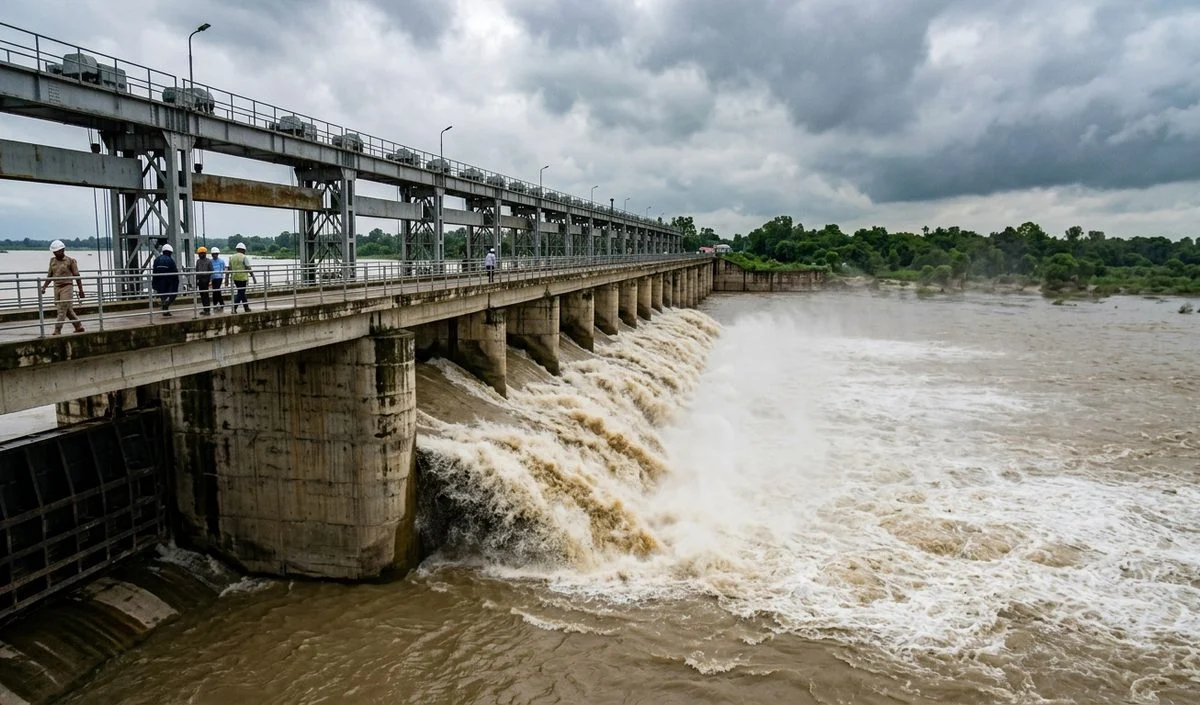
Emergency Mobilization Across Northern Bihar
State authorities in Bihar have activated a high flood alert following a severe surge in water levels arriving from neighboring Nepal. The rapid increase in the Gandak River forced water management officials to open all 36 sluice gates at the strategic Valmikinagar Barrage in West Champaran district. The measure was implemented to mitigate hydraulic pressure and prevent potential riverbank breaches further downstream.
Water release from the barrage reached nearly 150,000 cusecs by late Wednesday night, marking the peak discharge of the day. While hydrological assessments suggest the flow may soon begin to stabilize, administrative bodies across riverine districts have been instructed to maintain round-the-clock surveillance. The sudden swelling of the river system stems from severe flash flooding upstream in Nepal, which has caused widespread damage in central mountain corridors.
Catastrophic Trigger: Seismic Activity and Glacial Outburst
The downstream flood alert follows significant devastation across central Nepal earlier in the day. Reports indicate that a seismic disturbance in Tibet at approximately 8:37 AM local time was immediately followed by torrential floods down the Bhote Koshi river channel. Environmental and disaster officials indicate that the earth tremors likely triggered a glacial lake outburst flood, sending enormous volumes of water racing through narrow valleys.
The surge inflicted heavy casualties and structural ruin in Nepal:
- More than 150 deaths have been confirmed in severely impacted regions, including Rasuwa and Dhading districts.
- Over 750 individuals are listed as missing, including 133 Indian citizens present in the border state.
- Essential infrastructure suffered severe damage, with key transportation bridges washed away and roughly a dozen hydroelectric stations disabled.
Hydrological Data and Infrastructure Management
Positioned along the international border in West Champaran, the Valmikinagar Barrage serves as Bihar’s frontline defense against high flows originating in the Himalayas. Departmental authorities emphasized that while current flow rates are high, they remain considerably below extreme discharge records from previous years. By comparison, peak flow reached 224,000 cusecs on July 14, 2026, and scaled to a massive 562,500 cusecs during severe flooding on September 28, 2024.
Upstream river gauges provide some reassurance regarding overall capacity. Monitoring at the Devghat site along Nepal’s Narayani River—the primary tributary feeding the Gandak—recorded a water level of 4.77 meters. This figure remains safely beneath both the official warning mark of 7.30 meters and the danger threshold of 9.00 meters. Officials also noted that major eastern river systems, such as the Kosi, have shown no immediate signs of abnormal rising.
High-Level Administrative and Ministerial Response
Following news of the flood surge, Bihar Chief Minister Samrat Choudhary convened an emergency assessment meeting with Chief Secretary Pratyaya Amrit and high-ranking departmental leadership. Directives were issued to District Magistrates and police chiefs across bordering districts to establish emergency monitoring nodes and prepare civil protection measures.
Deputy Chief Minister Vijay Kumar Choudhary, who oversees the Water Resources Department, confirmed that a technical command team headed by a Superintending Engineer has been deployed directly at the Valmikinagar structure. Continuous monitoring of major embankments and drainage structures is underway to detect any signs of stress along the river walls.
District Vigilance and Disaster Response Deployment
High alert directives have been distributed to multiple sensitive districts situated along the river course. Key administrative zones under active monitoring include:
- West Champaran & East Champaran: Primary entry zones monitoring riverbank stability and immediate floodplains.
- Gopalganj & Saran: Downstream low-lying sectors with pre-positioned rescue teams.
- Muzaffarpur & Vaishali: Densely populated plains situated near vulnerable channel splits.
- Sitamarhi & Sheohar: Neighboring districts placed under precautionary flood watch.
National Disaster Response Force (NDRF) teams have been mobilized to Gopalganj and Bettiah, while an additional team remains on standby in Muzaffarpur. The Sashastra Seema Bal (SSB) has also committed quick-response support to assist local administration where necessary.
Civil Defense Measures and Bilateral Support
Municipalities and rural bodies in low-lying zones have begun using public address systems to notify communities near embankments, urging residents to stay cautious and secure assets. Local authorities have been directed to verify the availability of emergency shelters, community kitchens, flat-bottomed boats, and relief supplies should temporary evacuations become necessary.
Expressing sympathy for the lives lost in Nepal, Chief Minister Choudhary affirmed that India stands firmly beside its neighboring country during the crisis, noting that central assistance is being coordinated under the guidance of Prime Minister Narendra Modi. Emergency teams across Bihar remain stationed along vulnerable embankments through the overnight hours to ensure swift action if river levels change.
Leave a comment