
A Pre-emptive Shield Against Legislative Scrutiny
Months before upcoming midterm elections, the White House is erecting an aggressive legal framework designed to neutralize prospective congressional investigations. The strategy relies on expansive interpretations of presidential authority, asserting that executive secrecy protects not only internal government deliberations but also communications with private sector figures, informal attorneys, and outside allies who shape federal policy.
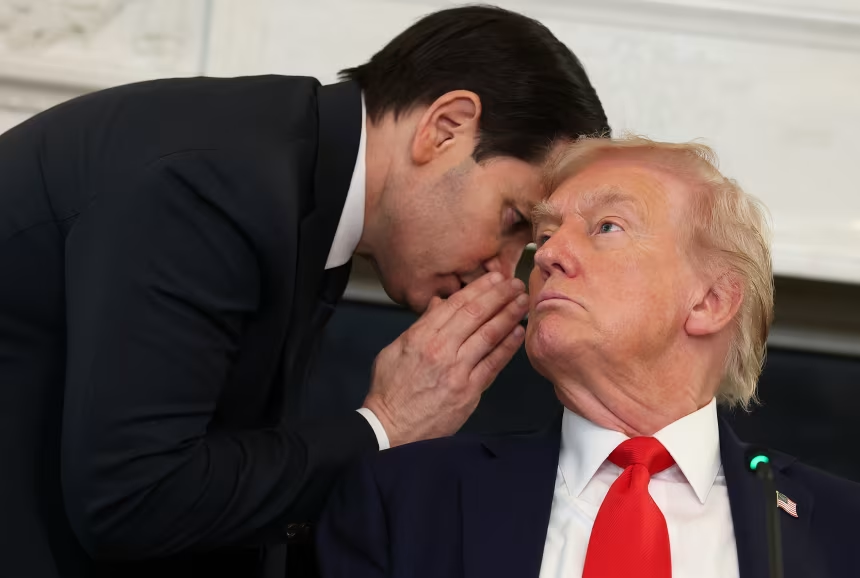
This proactive stance arrives as President Donald Trump leans heavily on a network of business moguls, private lawyers, and personal confidants to guide his second-term agenda. By classifying these external exchanges under executive privilege, the Department of Justice is attempting to set legal boundaries that could block future legislative subpoenas.
Extending Executive Privilege to Private Citizens
At the center of the administration’s defense is the argument that presidential confidentiality extends beyond official government personnel. In legal filings and internal Justice Department opinions, officials contend that restricting privilege solely to sworn executive branch staff would impede the president’s ability to seek candid external guidance.
White House spokesperson Lauren Bis defended this posture, stating that chief executives have traditionally relied on advisers outside government ranks. She argued that restricting privilege strictly to official staff would undermine the president’s capacity to draw on important non-governmental sources.
This legal argument is currently facing a key judicial test in a lawsuit filed by the American Bar Association challenging administration pressure on legal firms. In that proceeding, the Justice Department has moved to block a subpoena issued to Boris Epshteyn, a private attorney acting as an informal legal adviser to the president. Government lawyers assert that presidential privilege shields his interactions with the White House.
Hiding the Identities of Informal Policy Architects
Beyond shielding the contents of policy discussions, the White House has pushed executive secrecy even further by seeking to withhold the identities of outside consultants. In filings connected to the legal sector dispute, government attorneys claimed that revealing who advised the president on specific policies would create a chilling effect on internal White House communications and hamper candid policy evaluation.
Legal scholars emphasize that hiding the identities of non-governmental advisers pushes presidential secrecy claims into unstable territory. While constitutional privilege usually protects direct presidential communications, concealing consultant identities leans on deliberative process protections, which carry less legal standing.
Michael Bopp, chair of the congressional investigations practice at Gibson Dunn, noted that while such privilege arguments rest on fragile legal ground, lawmakers have limited immediate enforcement options to compel disclosure without entering protracted court battles.
The Challenge to the Presidential Records Act
In a parallel effort to limit oversight, the administration is challenging the 1978 Presidential Records Act. Enacted in the wake of the Watergate scandal, the statute requires the preservation of White House records and mandates their transfer to the National Archives at the end of a presidential term to ensure historical accountability.
However, an Office of Legal Counsel memorandum issued in April asserted that the law is unconstitutional, arguing that it represents an unlawful legislative intrusion into executive power. Bis reiterated this position, arguing that the statute violates the separation of powers and conflicts with historical norms regarding presidential documents.
Following the Justice Department opinion, the White House adjusted its document retention procedures, allowing staff greater freedom to delete certain digital messages. U.S. District Judge John Bates rejected the administration’s argument that the records law is unconstitutional, and the case is currently before a federal appeals court, with oral arguments set for October.
Opponents of the administration’s stance, including more than a hundred Democratic lawmakers who submitted court filings, argue that striking down document preservation rules threatens national security, government continuity, and public oversight. Critics warn that abandoning record retention allows officials to operate without contemporaneous documentation that could verify or refute public statements.
Private Sector Figures Caught in the Crossfire
For private individuals and corporate entities interacting with the White House, the administration’s legal theories create a complex environment. Congressional investigators are preparing to examine interactions involving international sports organizations like FIFA, ties to the cryptocurrency sector, and potential overlaps between Trump family business interests and federal policy decisions.
Former congressional oversight counsel Jamie Bair, now at Crowell & Moring, highlighted that private figures caught in legislative inquiries face intense public pressure. While executive privilege claims may offer procedural delay during negotiations, lawmakers can exert significant leverage through public hearings, potential contempt citations, and pressure from investors and state regulators.
Legal expert Tara Ganapathy of K&L Gates noted that non-governmental targets do not hold the same constitutional protections as executive branch officials. However, she observed that official Justice Department opinions still provide private targets with significant procedural bargaining chips when responding to legislative subpoenas.
Long-Term Scrutiny and Enforcement Options
With court challenges routinely taking months or years to resolve, White House strategists anticipate that legal delays could push oversight battles past the end of the presidential term. Nevertheless, congressional aides indicate that lawmakers are planning alternative pressure tactics beyond judicial enforcement to compel compliance from non-governmental actors.
As the legal battles unfold in federal appeals courts and district forums, the outcome promises to redefine the boundaries of executive confidentiality, the enforceability of congressional subpoenas, and the transparency of informal advisers in shaping federal policy.
Leave a comment